
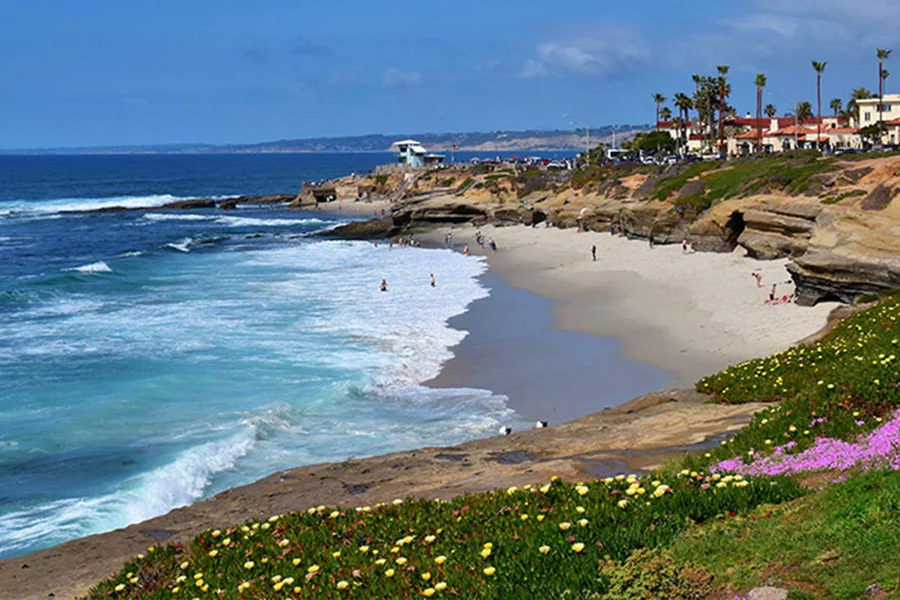
La Jolla sits on a stretch of San Diego coastline that doesn’t look entirely real. Sandstone cliffs drop into water that shifts from jade to deep blue depending on the light. Sea caves open into hidden coves. Harbor seals sprawl across a public beach without anyone shooing them away. It’s the kind of place that makes first-time visitors stop mid-sentence.
The name translates roughly from Spanish as “the jewel,” and while place names often oversell their subjects, this one holds up. La Jolla covers about seven miles of San Diego County’s northern coastline, sits roughly 12 miles north of downtown San Diego, and has built a reputation over the past century as one of the most concentrated combinations of natural beauty, cultural infrastructure, and culinary depth anywhere on the California coast.
The Coastline That Sets La Jolla Apart
Most beach towns have one defining coastal feature. La Jolla has several packed into a short stretch of shoreline, and they’re genuinely different from each other.
La Jolla Cove is the anchor — a small protected inlet where visibility of 20 to 30 feet on a calm day is common. The cove is part of the San Diego-La Jolla Underwater Park, a protected ecological reserve covering about 6,000 acres of ocean floor. No fishing, no collecting. The result, over decades of protection, is a healthy underwater ecosystem: garibaldi fish, leopard sharks in the shallows, kelp forests starting about 100 yards offshore.
Children’s Pool Beach sits a quarter mile south. Built in 1931 with a concrete seawall to create calm water for children, harbor seals took it over in the 1980s. A years-long legal dispute over beach access eventually settled in favor of the seals during pupping season. Today it’s one of the only places in California where you can stand a few feet from a colony of wild Pacific harbor seals. It’s an only-in-La-Jolla situation that’s hard to appreciate until you’re standing there.
La Jolla Shores, further south, is the widest family-friendly beach — flat sand, gentle surf, a boat launch. The La Jolla Sea Caves run along the northern cliffs: seven caves total, most accessible by kayak or paddleboard, including Sunny Jim Cave, reachable via a tunnel cut through the cliff in 1902.
Why the Cliffs Matter as Much as the Beach
La Jolla is one of the few Southern California coastal communities where the cliff-top experience rivals what’s at sea level. The Coast Walk Trail runs along the bluffs from the cove north toward Torrey Pines — at points you can look directly down into the clear water below, and on days when the swell is running, the wave action against the sandstone is worth the walk alone.
Ellen Browning Scripps Park, the grassy clifftop area above La Jolla Cove, faces west and fills at sunset with locals and visitors. No vendors, no infrastructure — just the view.
The cliffs are Torrey sandstone, which erodes in visually interesting ways: arches, overhangs, tide pools at the base. The same formation continues north to Torrey Pines State Natural Reserve, which protects one of only two native stands of the Torrey pine — the rarest pine in the United States — across 2,000 acres of coastal mesa and beach. The reserve has been protected since 1921.
La Jolla as a Cultural Destination
The natural assets are obvious. Less obvious is how much cultural infrastructure La Jolla has for a neighborhood of about 45,000 people.
The Museum of Contemporary Art San Diego (MCASD) has its main campus here, in a building Irving Gill designed in 1916 that was renovated and expanded in 2021. The collection focuses on work from 1950 onward, with strength in Southern California artists, and the building’s position above the ocean gives it a physical context few art museums can match.
UC San Diego opened in 1960 on the mesa above La Jolla and now enrolls about 40,000 students. The Scripps Institution of Oceanography — operating since 1903 — has made La Jolla one of the more significant marine science communities on the West Coast. The Birch Aquarium at Scripps is a working research aquarium open to the public, with live kelp forest tanks and exhibits on local marine ecosystems.
The La Jolla Playhouse, founded in 1947 by Gregory Peck, Dorothy McGuire, and Mel Ferrer, has sent productions like “Jersey Boys,” “I Am My Own Wife,” and “The Who’s Tommy” to Broadway. For a neighborhood of this size, that’s a remarkable cultural footprint.
What to Eat: La Jolla’s Restaurant Scene
George’s at the Cove has been the standard-bearer since 1984. Three floors, three different dining experiences — the Ocean Terrace is the most accessible, an open-air deck with direct Pacific views serving Californian cuisine that leans on local seafood. Reliably excellent, reliably busy; book ahead, especially for the rooftop.
Brockton Villa, a converted 1894 craftsman bungalow on Coast Boulevard above the cove, serves breakfast and lunch in a setting most restaurants couldn’t manufacture. The French toast is what people mention, which undersells the rest of the menu, but isn’t wrong.
The village — Prospect Street and Girard Avenue — has enough independent restaurants and wine bars that you could eat well for a week without repeating. The density of quality dining relative to the square footage is unusual, and it’s one of the practical reasons travelers who discover La Jolla tend to return.
Snorkeling, Kayaking, and Getting Into the Water
Equipment rental is right at the cove — fins, mask, wetsuit — and marine life starts almost immediately once you’re in. Garibaldi, California’s state marine fish, are bright orange, roughly the size of a dinner plate, and territorial enough that they come to investigate rather than hide.
The leopard sharks are worth planning around. From July through October, female leopard sharks congregate in the warm shallows of La Jolla Shores to gestate their pups. They’re harmless — bottom feeders that don’t bite — but swimming alongside a four-foot shark in two feet of water is a different experience than reading about it. The aggregation draws snorkelers and divers from across the region during peak months.
Kayak tours of the sea caves leave from La Jolla Shores daily through most of the year. The standard tour takes about two hours and covers most of the seven caves along the northern cliffs. Book in advance on summer weekends — demand regularly outpaces availability.
Where to Stay: Understanding Your Options
The Lodge at Torrey Pines is the flagship — 170 rooms, craftsman-style, adjacent to the Torrey Pines Golf Course and the state reserve, opened in 2002. The Grande Colonial on Prospect Street has been operating since 1913. Chain properties cluster near the I-5 corridor.
For longer stays or groups, vacation rentals tend to outperform hotels: full kitchens, more space, the ability to eat breakfast before heading to the cove. The inventory of La Jolla vacation rentals skews upscale — this is one of San Diego’s more affluent neighborhoods — meaning quality is high and so are prices. For stays of four or more nights, the trade-off usually favors a rental.
Location within La Jolla matters. Properties walkable to the cove and the village put you in reach of the best restaurants and most dramatic scenery without a car. Properties inland, near UCSD or I-5, are quieter and cheaper but require driving to most of what makes La Jolla worth visiting. Between a smaller unit near the water and a larger one further out, the smaller unit usually wins.
How La Jolla Compares to Other California Coastal Towns
Carmel-by-the-Sea comes up most often in comparisons — another small, upscale coastal community with a strong arts identity and dramatic scenery. Both have excellent dining, walkable villages, and natural settings that define the experience. Carmel has the 17-Mile Drive and Big Sur as its backyard; La Jolla has Torrey Pines and, on clear days, the Channel Islands visible offshore.
The practical difference is scale. Carmel has about 3,000 residents and can feel like a stage set on peak summer weekends. La Jolla is embedded in a major metropolitan area — San Diego International Airport is 15 miles south — which means more infrastructure, more variety, and easier access. For a California coast trip that prioritizes natural beauty alongside genuine cultural amenity, La Jolla makes a stronger case than most people expect.
Travelers who’ve experienced Mission Beach or Pacific Beach — San Diego’s denser, more energetic beach communities — find La Jolla operates on a different register. Anyone who has stayed in a beach house San Diego rental near the boardwalk and wants something calmer will find La Jolla is essentially a different experience: same city, different world.
Why La Jolla Qualifies as One of California’s Most Beautiful Coastal Destinations
California has no shortage of beautiful coastline — Big Sur, Point Reyes, the Marin Headlands, Mendocino. La Jolla earns its place in that conversation for a specific combination of reasons others can only partially match.
The underwater park gives the water a clarity most California beaches lack. The sandstone cliffs create a vertical dimension that flat beaches don’t have. The cultural infrastructure — MCASD, La Jolla Playhouse, Scripps Institution, world-class restaurants — means the visit doesn’t depend entirely on good weather. The harbor seal colony at Children’s Pool is one of a kind. And the scale is right: large enough to sustain itself as a destination, small enough to walk end to end in 20 minutes.
La Jolla is one of California’s most beautiful coastal destinations not because of any single feature but because of how many distinct things it does well in a concentrated geography. Natural, cultural, culinary — that density of quality in a place you can walk across in 20 minutes is what makes it worth the trip, and what brings people back.