
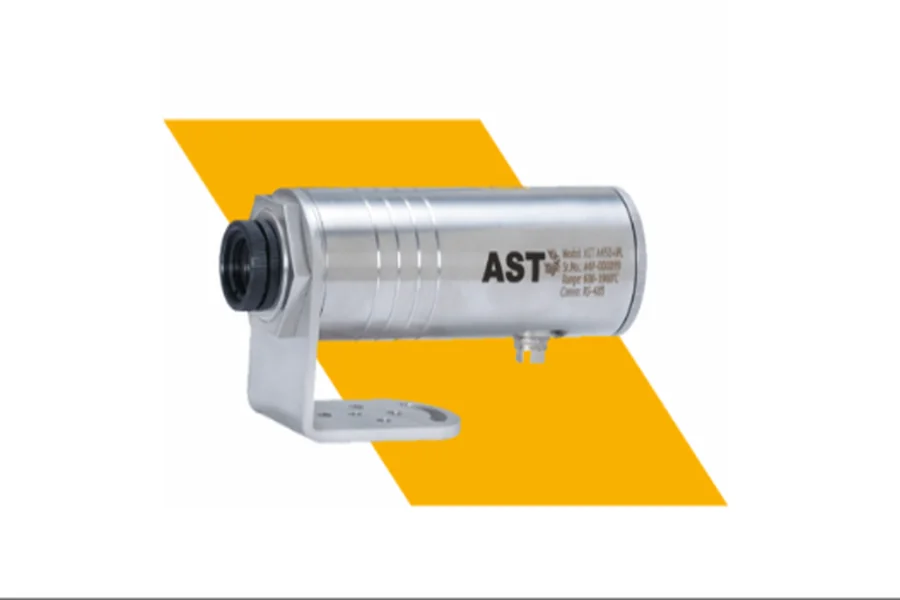
In industrial temperature measurement, precision and dependability are important. Accurate temperature measurement is crucial for getting high-quality results in glassmaking, food processing, metal forging, or laboratory research.
Pyrometers and thermocouples both have their advantages and are most suitable for specific uses. But which is best for your process?
Let us find out what these two devices are when comparing pyrometers to thermocouples, it’s necessary to consider the factors affecting temperature readings in practical industrial applications. The accuracy of temperature measurements is not just a function of the equipment used, but also factors including surface emissivity, environmental noise, sensor location, and calibration.
Even small errors can influence product quality, safety, and productivity in high-tech industrial applications. For instance, reflective surfaces such as polished metals can affect IR measurements, and therefore pyrometers can be slightly less accurate unless calibrated. Likewise, thermocouples can drift over time if subjected to harsh environments for a prolonged period.
Another important factor is system integration. In automated production lines, temperature sensors often work alongside pneumatic and mechanical systems. Components such as an airtac cylinder may indirectly influence measurement stability by affecting positioning, movement, or vibration within the system. Ensuring proper alignment and minimal disturbance helps maintain consistent readings.
Furthermore, speed and maintenance should be evaluated. Pyrometers provide immediate results, while thermocouples need to be in contact and checked regularly. Thus, the selection of the device depends not only on the range of temperature but also the conditions, process and maintenance requirements.
Through careful consideration of these factors, industries can avoid potential mistakes and choose a temperature measurement device that offers both accuracy and reliability.
What Are Pyrometers?
A pyrometer is a non-contact temperature measuring instrument. Apart from contacting the surface, it employs infrared or optical radiation discharged by an object to identify its temperature.
Modern pyrometers come with infrared sensors, which are also known as IR pyrometers. They are utilised much in industries where direct contact is not possible, such as with hot glass, molten metals, or moving parts on a manufacturing line.
Essential Benefits
- They are non-contact temperature-measuring instruments. They are ideal for very hot or dangerous surfaces.
- They are known for a faster response and can read the temperature in seconds.
- They are harmless as there is no risk of product contamination or sensor corrosion.
- They are very temperature-friendly and can read temperatures above 1,000°C (1,832°F).
What Are Thermocouples?
Thermocouples are temperature-measuring instruments constructed by merging two dissimilar metal wires at one end. The junction will generate a small voltage when there is any variation in temperature at the intersection. It is a very prominent temperature-measuring device due to its simplicity, potential, and various applications. You can find them easily in everything from cooking stoves to industrial furnaces and scientific laboratories.
Key Benefits
- They offer a wide temperature measurement range. Based on type (Type J, K, or R), you can take readings from -200°C to 2,500°C.
- They are small and adaptable and can be simply fixed in a small and constricted area.
- They are contact temperature measurement tools. They deliver easy and quick food temperature readings anywhere you need them. Thermocouples are relatively inexpensive to replace and not too costly to install, primarily.
When Can You Use A Pyrometer?
Select a pyrometer if:
- Measuring very high temperatures, and no direct contact with the sensor is required.
- Your aim is a moving one, such as hot steel sheets on a transit conveyor.
- The material is too harmful to touch, like corrosive, electrified, or toxic.
- You want quick readings from a distance, which is easy for constant monitoring.
- You have as little sensor damage as feasible.
Pyrometers are important for industries, for example, steel manufacturing and glassmaking, forges, kilns, foundries, and at places within the automotive or aerospace niche where temperature requires being closely checked during operations like forging and heat treatment.
When Can You Use A Thermocouple?
Select a thermocouple if:
- You need precise direct contact temperature readings.
- The environment is perfect for setting up the sensor securely.
- You are keeping a record of enclosed systems like ovens, furnaces, or chemical reactors.
- You need to measure internal temperatures, such as inside pipes, liquids, and even internal organs, by offering an extra function to your device.
Thermocouples are the best choice for use in laboratories and various industrial applications, such as petrochemical or refining plants, food and beverage processing, as well as HVAC and industrial control systems. They can adapt to any shape, making them perfect for multi-point tracking of big equipment.
Can You Use Both?
Yes. Various industries use a mix of both tools. A steel factory, for example, can use pyrometers to do quick surface verifications on molten metal, and thermocouples to check internal temperatures over time.
Using both methods, you can obtain a comprehensive temperature profile for increased control of quality and process security.
Choosing the Right Instrument for Your Industrial Process
There is no one-size-fits-all rule. The decision to employ a pyrometer or a thermocouple is based on your process requirements:
- Are you looking for faster non-contact readings? Then go for a pyrometer.
- Is your target critical or on the move? Choose a pyrometer.
- Are you considering monitoring interiors or even constant surfaces? Pick a thermocouple.
- Are you restricted by budget? Thermocouple is a more economical option.
- Does it need extreme accuracy where your finger hits? Choose a thermocouple.
Also, remember the operating environment over the longer term, as dust, vibration, or chemicals can cause you to think about a different tool.
Conclusion
Pyrometers and thermocouples are well-suited for different applications. Understanding how they work and when to use them will let you measure temperature more effectively, keep your processes running well, and protect your equipment. Whenever you measure industrial temperatures, consider your choices carefully, and you will surely have an appropriate tool for the work every time. For more technical details on these two instruments, please visit Tempsens.