
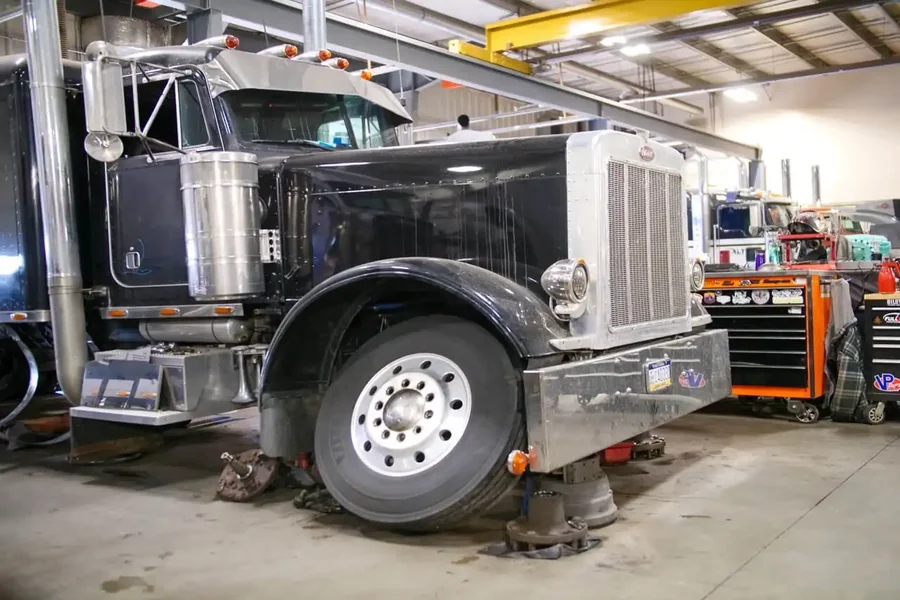
Heavy-duty trucks are built to take punishment. A Class 8 semi can log 500,000 miles or more before a major overhaul becomes unavoidable — if it’s maintained properly. That “if” does a lot of work. The mechanical issues that sideline commercial trucks most often aren’t catastrophic failures that come out of nowhere. They’re familiar problems that escalate because they were caught late, diagnosed wrong, or deferred one service interval too many.
This isn’t a theoretical list. It’s drawn from the patterns that fleet managers, independent owner-operators, and diesel technicians see repeatedly. If you run heavy trucks commercially, most of what follows will be familiar. The question is which items are getting ahead of you.
Engine Problems: Where Downtime Usually Starts
Coolant and Oil System Failures
Cooling system failures rank among the most common roadside breakdown causes in Class 7 and 8 trucks. Degraded coolant, failing water pumps, cracked hoses, and clogged radiators are the usual suspects. What makes these failures expensive isn’t the repair — it’s the downstream consequence. Running a diesel at elevated temperatures even briefly can cause head gasket failure, liner protrusion in wet-sleeve engines, and in serious cases, bore scoring that requires a full rebuild. The Federal Motor Carrier Safety Administration (FMCSA) consistently lists lubrication failures among the leading factors in commercial vehicle out-of-service orders during roadside inspections.
Fuel System Issues
Modern high-pressure common-rail (HPCR) fuel systems run at injection pressures exceeding 30,000 psi. At those pressures, contamination tolerance is essentially zero. Water in fuel causes injector corrosion; clogged filters cause power loss and hard starts; gradual injector wear produces rough idle and increased fuel consumption. A single injector replacement runs $300 to $600 — a full set on a six-cylinder engine adds up quickly, which is why fuel system maintenance deserves real attention rather than routine box-checking.
Brake System Failures: The Safety-Critical Issue You Can’t Defer
Brake problems are the single most common out-of-service violation found during Commercial Vehicle Safety Alliance (CVSA) roadside inspections. In the 2023 International Roadcheck — which inspected over 67,000 commercial vehicles across North America over 72 hours — brake-related violations accounted for the largest share of vehicle out-of-service orders. That statistic has held roughly consistent for years.
Heavy-duty trucks use air brake systems, which fail differently than the hydraulic systems in passenger vehicles. The most frequent issues: brake adjustment failures, where automatic slack adjusters don’t maintain proper pushrod travel as linings wear; air system contamination, where failed air dryers allow moisture into brake components, causing freezing in cold conditions and corrosion year-round; and brake lining wear, particularly on steer axles. Metal-on-metal contact from worn linings damages rotors and in severe cases causes brake failure on the steer axle.
Drivetrain and Transmission Issues
Automated manual transmissions (AMTs) — now standard from Freightliner, Kenworth, Peterbilt, Volvo, and Paccar — have different failure modes than traditional manuals: shift actuator failures, clutch wear the control module masks until it can’t, and fault codes requiring dealer-level diagnostics. AMTs also log operational data, which means unusual shift patterns and clutch abuse leave a record.
Driveshaft U-joints are unglamorous but critical. Vibration that starts barely noticeable at highway speed will eventually damage the transmission output shaft, differential, or both. Catching a failing U-joint during a PM costs almost nothing compared to catching it after it destroys adjacent components. Differential failures are less frequent but typically preceded by an audible whine or clunk under load that gets misattributed to road noise or tires — regular gear oil changes and maintained fluid levels prevent most of them.
Electrical System Faults: The Modern Diesel’s Achilles Heel
Modern heavy trucks are deeply computerized. A late-model Kenworth T680 or Freightliner Cascadia has multiple ECMs, a CAN bus network, and hundreds of sensors monitoring exhaust aftertreatment temperatures, suspension ride height, and dozens of other parameters. This enables real-time diagnostics — and introduces failure modes that didn’t exist 20 years ago.
Aftertreatment sensor failures are the most common electrical issue. NOx sensors, DPF differential pressure sensors, and SCR temperature sensors fail regularly and trigger active derate events that limit engine power to a fraction of rated output. A truck that can only make 60% throttle can’t meet its schedule. A truck in active derate on a grade or in heavy traffic creates direct safety exposure.
Wiring harness damage compounds sensor failures. Road vibration, heat cycling, and chafing against frame members damage wiring over time. Intermittent faults are the hardest to diagnose because they don’t set persistent codes — they appear under specific conditions and disappear on the shop floor. Battery testing at each PM, rather than visual inspection alone, prevents the predictable dead-battery failure at a shipper dock on a cold morning.
Exhaust Aftertreatment: The Emissions System Maintenance Nobody Loves
The emissions systems required by EPA regulations finalized in 2007 and 2010 — diesel particulate filters (DPF), selective catalytic reduction (SCR), and exhaust gas recirculation (EGR) — added significant maintenance complexity to modern diesels. Every fleet manager running post-2007 equipment deals with this operationally.
DPF plugging is the most common aftertreatment issue. Trucks operating on short local cycles don’t generate the exhaust temperatures needed for passive regeneration, leading to premature plugging and forced parked regen events that take 45 minutes to an hour and ground the truck completely. DPFs that aren’t properly maintained eventually need forced cleaning or replacement — running $1,500 to $3,000 depending on filter size and cleaning method.
EGR cooler failures are less frequent but more damaging. When an EGR cooler cracks, it can introduce coolant into the intake tract, which then enters the combustion chamber. Piston, liner, and turbocharger damage from this kind of event can escalate quickly into major engine repair territory.
Tires and Suspension: What the Road Does to Heavy Equipment
A fully loaded Class 8 truck puts steer axle loads of 12,000 to 14,000 pounds on its front tires and up to 34,000 pounds on its rear tandems. Underinflation is the single most destructive thing that happens to commercial truck tires — it causes heat buildup, accelerates shoulder wear, and leads to tread separation. Tire pressure monitoring systems are standard on new equipment, but only help if operators respond to alerts.
Alignment issues compound tire wear. Steer axle misalignment causes rapid, uneven wear on tires costing $500 to $800 each. Front end components — tie rod ends, kingpins, wheel bearings — wear progressively and require mileage-based inspection, not just driver reports of a pull.
Suspension failures — cracked leaf springs, failed air bags, worn torque rod bushings — affect handling and load capacity. A blown air bag on a loaded truck can shift cargo in ways that create safety and liability exposure beyond the immediate repair.
When a Breakdown Happens: What Comes Next
Even well-maintained trucks break down. The response to a mechanical failure — especially on the road — shapes how quickly the situation gets resolved and what the total cost ends up being. A truck with a blown steer tire on an interstate requires a different response than a truck with a failed injector at a terminal.
Operators in the Northeast know the specific landscape of commercial breakdown response — the distances between service infrastructure, the traffic patterns that affect response times, the jurisdictions with specific rules for commercial vehicle recovery. For situations requiring heavy duty towing, response time is the variable that matters most: every hour a loaded truck sits disabled on a shoulder is an hour of schedule impact, potential cargo claim exposure, and driver hours-of-service complication.
The most common mechanical issues in heavy-duty trucks don’t become emergencies instantly. They build. The deferred maintenance interval, the acknowledged-and-forgotten warning light, the noise everyone decides to watch rather than investigate: these are where roadside calls originate. Systematic PM programs catch most of them before they become breakdowns. The ones that slip through are where professional semi truck towing and roadside repair capabilities become the difference between a manageable disruption and a significant operational event.
The Most Common Mechanical Issues in Heavy-Duty Trucks: What the Pattern Tells You
Look at the failure categories above and a pattern emerges. Most share the same origin: a maintenance task deferred, a symptom misread, or a system complex enough that the people responsible stopped fully understanding it. Engine cooling failures, brake violations, drivetrain wear, wiring faults, aftertreatment plugging — they’re all preventable with the right program, the right intervals, and technicians who know what they’re looking for.
The most common mechanical issues in heavy-duty trucks are common precisely because the economics of commercial trucking push against the time and cost of proper maintenance. The math that favors deferring a PM today looks different after a roadside breakdown, a failed inspection, or a repair bill for damage that started as something minor and became something major while nobody was looking closely enough.