
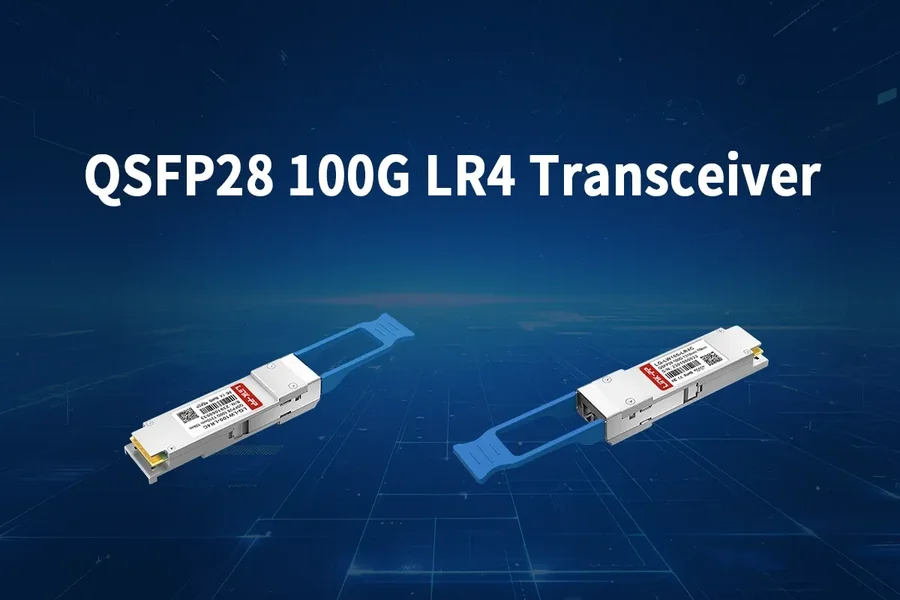
For a long time, 100G Ethernet looked like something reserved for hyperscale cloud providers and telecom backbones. Enterprise networks watched from a distance, assuming that 40G or aggregated 10G links would be enough for many years.
That assumption is starting to break down. Virtualization, centralized storage, video-heavy collaboration tools, and internal AI workloads are quietly changing traffic patterns. What used to be a predictable east-west flow inside a data center has turned into something much heavier and far less forgiving.
In this transition, 100GBASE-LR4 has become one of the most realistic entry points into 100G networking for organizations that cannot justify exotic optics or radical architectural changes.
What Makes 100GBASE-LR4 a Conservative 100G Choice
100GBASE-LR4 is not a cutting-edge standard. It does not chase extreme reach or ultra-high density. Instead, it focuses on one clear mission: delivering 100 gigabits per second over single-mode fiber for distances up to 10 kilometers using a mature, well-understood design.
It uses four optical lanes around the 1310 nm wavelength, multiplexed onto a single fiber pair. This architecture is conceptually similar to 40GBASE-LR4, which gives it a sense of continuity that many engineers appreciate.
In practice, that means fewer surprises. The technology is stable, broadly supported, and predictable in behavior, which matters far more in production networks than theoretical performance ceilings.
Most organizations do not wake up one morning and decide they “want” 100G. The decision usually comes from quieter signals.
Backup windows start running too long. Virtual machine migrations feel sluggish. Database replication jobs begin to overlap with business hours. Monitoring dashboards show persistent congestion during peak times.
Individually, these symptoms do not look dramatic. Together, they create a constant background friction that slowly pushes teams toward higher bandwidth.
100GBASE-LR4 often appears at exactly this point. It is fast enough to relieve real pain without forcing a full redesign of the network.
Reusing Fiber Assets Instead of Rewriting History
One of the biggest reasons 100GBASE-LR4 feels so practical is its compatibility with existing single-mode fiber infrastructure.
Many enterprise campuses, industrial sites, and multi-building facilities already have long runs of single-mode fiber in the ground or in conduit. Replacing that fiber is expensive, slow, and often politically difficult inside large organizations.
100GBASE-LR4 allows teams to increase capacity dramatically without touching the physical plant. That alone can make the difference between a feasible project and one that never gets approved.
In real-world deployments, 100GBASE-LR4 is rarely used everywhere. It usually shows up first in specific roles.
Core-to-core interconnects are a common starting point. These links carry aggregated traffic from multiple access layers, making them natural bottlenecks. Upgrading just a handful of these links to 100G can deliver an immediate performance improvement across the entire environment.
Inter-building or inter-campus links are another frequent use case. Here, the 10 km reach becomes especially valuable, allowing direct connections without intermediate aggregation points.
The Psychological Barrier of Moving to 100G
There is a non-technical side to every major upgrade.
For many teams, 100G still feels like a psychological leap. It sounds expensive, complex, and risky, even when the actual numbers are manageable. Decision-makers worry about compatibility, support contracts, and whether their teams are ready to operate at this scale.
100GBASE-LR4 lowers that psychological barrier. It feels like an evolution rather than a revolution. The optics look familiar. The fiber looks familiar. The operational behavior looks familiar.
That sense of continuity matters more than most technical whitepapers admit.
Modern switches pack a lot of performance into small spaces. That density comes with thermal consequences.
Compared to shorter-reach optics or newer long-haul modules, 100GBASE-LR4 sits in a comfortable middle ground. Its power consumption is not trivial, but it is predictable and manageable. It does not push thermal limits the way higher-power coherent modules do.
In data centers where rack-level power density is already under pressure, this balance becomes a real design constraint rather than a theoretical one.
Cost Behavior Beyond the Purchase Order
The upfront price of 100GBASE-LR4 optics is often the first thing people look at, and it can cause sticker shock.
But hardware decisions live far longer than their procurement cycles. Over five or seven years, the cost of optics becomes just one part of a much larger financial picture.
Fewer links mean fewer ports, fewer cables, fewer switch line cards, and fewer failure points. Over time, those reductions translate into real operational savings.
In many cases, a well-placed 100GBASE-LR4 upgrade pays for itself not through raw performance, but through architectural simplification.
When teams start talking about 100G, someone inevitably brings up ZR or coherent solutions.
Those technologies are impressive, but they solve a different problem. They are built for long-haul, metro, or data center interconnect scenarios measured in tens or hundreds of kilometers.
For internal enterprise networks, that capability is usually unnecessary. Choosing coherent optics in those cases adds cost, power consumption, and operational complexity without delivering meaningful benefits.
100GBASE-LR4 stays grounded in what most organizations actually need: reliable medium-reach performance at a manageable complexity level.
Operational Familiarity as a Strategic Advantage
There is a quiet advantage to choosing technologies that your team already understands.
Troubleshooting becomes faster. Documentation is easier to maintain. Training new staff takes less time. Vendor support interactions are more predictable.
100GBASE-LR4 benefits from a long history in the market. Most network engineers have already worked with LR-class optics, even if only at 10G or 40G.
That shared operational memory reduces friction in ways that do not show up on specification sheets.
No technology is universal.
If your environment is extremely dense and short-reach focused, 100G SR4 or DAC solutions may offer better cost and power efficiency. If your links extend far beyond 10 km, ZR-class optics become unavoidable.
100GBASE-LR4 sits in the middle. It is not optimized for extremes. It is optimized for balance.
Understanding that positioning is key to using it wisely.
Conclusion
100GBASE-LR4 is not about chasing the future. It is about stabilizing the present. For enterprises facing real, measurable bandwidth pressure but unwilling to gamble on bleeding-edge technologies, it offers a grounded, practical path into 100G networking. By combining familiar design principles with meaningful capacity gains, it bridges the gap between legacy infrastructure and modern performance demands. In many environments, that balance is exactly what sustainable growth looks like.